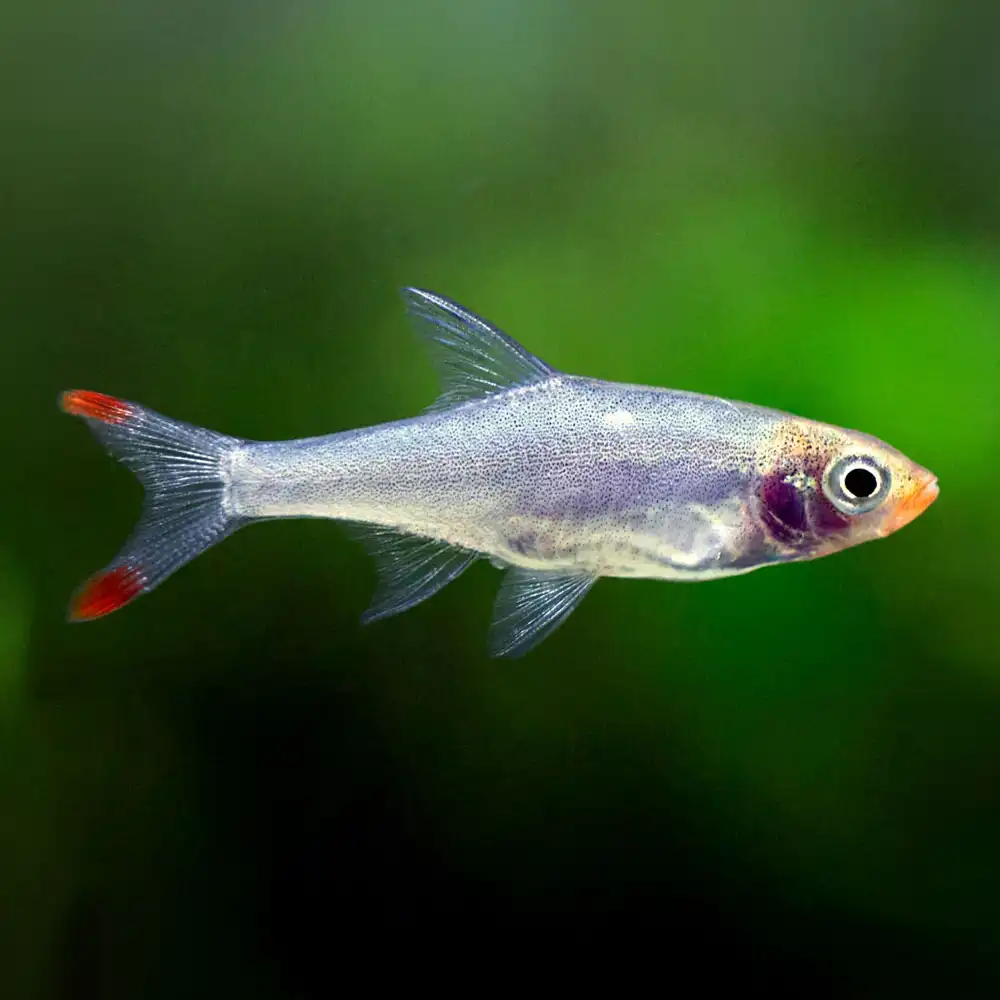
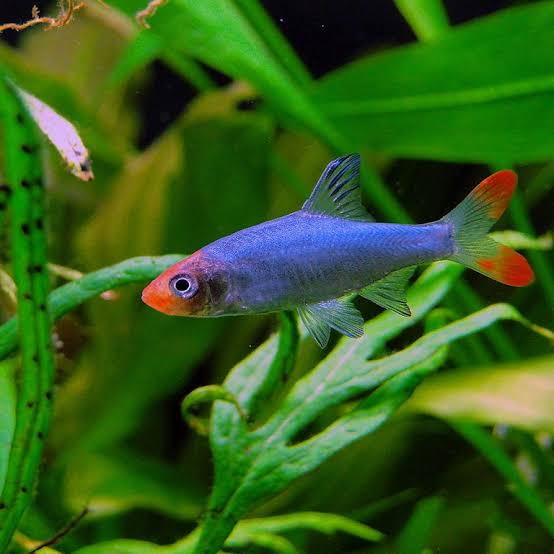
The "Rasbora Sawbwa" (scientific name: Sawbwa resplendens) is a misnomer; despite being widely marketed as the Rummynose Rasbora, Asian Rummynose, or Naked Microrasbora, it is not a true rasbora. It belongs to its own unique, monotypic genus (Sawbwa) within the cyprinid family. This endangered nano fish is entirely endemic to the high-altitude wetlands of Inle Lake in Myanmar and is uniquely famous for being completely scaleless.
🐠 Appearance & Dimorphism
• Size: Reaches a tiny maximum size of 3.5 cm (1.4 inches).
• Males: Display a striking iridescent silvery-blue body with a bright red nose (snout) and red tips on the tail fin lobes.
• Females: Much more subdued, presenting a plain silvery-gray to olive color with a dark pigmentation spot near the anus.
💧 Aquarium Care Parameters
Because Inle Lake is an isolated, cool, and hard water environment, their aquarium needs differ slightly from typical tropical nano fish:
• Tank Size: Minimum 40 to 60 litres (15–20 gallons) to allow adequate swimming space.
• Temperature: Prefers cooler water, ideally 18–22°C (64–72°F). They do not tolerate prolonged heat well and should not exceed 25°C (77°F).
• Water Chemistry: Requires hard, slightly alkaline conditions. pH of 7.0–8.0 and a water hardness of 5–15 dGH (with a high carbonate hardness).
• Environment: Heavy live planting with dark substrate helps bring out the males' intense colors. Keep the water flow gentle to moderate.
⚖️ Behavior & Stocking
• Social Structure: They are a shoaling species that must be kept in groups. While online communities on platforms like Aquarium Co-Op note their independent exploration habits, a minimum group of 6 to 8 (ideally 12+) is necessary to prevent severe shyness.
• Gender Ratio: Males are territorial and will constantly spar for dominance. To diffuse aggression, aim for a heavily female-biased ratio—ideally 2 to 4 females per male.
• Tank Mates: Exceptionally peaceful community fish. Best housed with other tiny, non-aggressive species like dwarf shrimp, small danios, microdevarions, or corydoras. Avoid long-finned or boisterous fish.
🍽️ Diet & Feeding
They are small-organism micro-predators. Give them micro-sized foods such as live or frozen baby brine shrimp (Artemia), Daphnia, Cyclops, crushed high-quality flakes, and micro pellets.
SKU: RS-0095