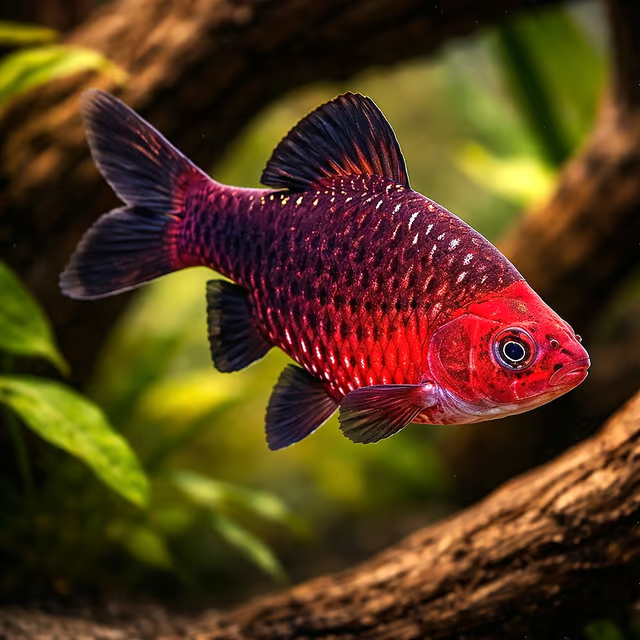
The Black Ruby Barb (Pethia nigrofasciata), also commonly known as the Purple-Headed Barb, is a hardy, peaceful, and visually striking freshwater schooling fish endemic to the shaded forest streams of Sri Lanka. Because wild populations are vulnerable and protected, all fish available in the commercial hobby are captive-bred.
🌟 Key Characteristics & Appearance
• Sexual Dimorphism: Juveniles and females generally display a subdued tan or yellowish-gray body featuring three prominent vertical black bands. As males mature (around 6 to 8 months), they develop an intense, deep crimson to reddish-purple head and a dark, burning cocoa or velvet-black body with solid black fins.
• Size & Lifespan: They reach a maximum size of 5 to 6.7 cm (around 2 to 2.5 inches), with females often growing slightly larger and rounder than males. They can live up to 5 years with proper care.
• Behavior: They are highly active, playful, and completely peaceful tank inhabitants that do not nip fins, unlike some other notorious barb species.
🏠 Tank Requirements & Water Parameters
Because they are shoaling fish, they must be kept in a group of at least 6 or more. Keeping them in a group helps reduce stress and encourages males to display their most vibrant, competing spawning colours.
• Minimum Tank Size: 80 litres (approx. 20–30 gallons) or larger to allow for a proper school and active swimming room.
• Temperature: 22°C to 26°C (72°F to 79°F).
• pH Range: 6.0 to 7.0 (Farm-raised stock are highly adaptable, but they appreciate stable, slightly acidic to neutral water).
• Hardness: 5 to 12 dGH.
• Setup Style: They thrive best in a well-planted setup with a dark substrate, plenty of hiding places, and floating plants to provide natural shaded areas that mimic their wild stream environments.
🍽️ Diet & Feeding
Black Ruby Barbs are unpicky benthic omnivores. To keep them healthy and enhance the intense red coloration in males, provide a varied diet:
• Base Diet: High-quality tropical flakes, micro-pellets, or granules.
• Color-Enhancing Supplements: Regular offerings of live or frozen foods like Daphnia, bloodworms, brine shrimp, and mosquito larvae.
• Vegetable Matter: They naturally graze on filamentous algae and detritus, so incorporating blanched spinach, zucchini, or spirulina flakes is highly beneficial.
SKU: BR-0185